Gesher School Logo
  • The Bridge
  • Join Our Team
  • Admissions
  • Home
  • About us
    • Aims Vision & Ethos
    • Who We Are
      • Who We Are
      • Staff
      • Governance
      • Trustees
    • Policies
    • School Prospectus
    • Join our team
      • Join our team
      • Why join Gesher School?
    • Ofsted Report
    • Admissions
      • Admissions
      • Application Form
      • Open Mornings
    • Blueprint
    • SEND Information Report
    • Contact us
  • Parents
    • Who to talk to at school
    • Home school Agreement
    • Term Dates
    • Family Support Worker
    • Uniform
    • School lunches
    • Parent Resources
      • Parent Resources
      • Testimonials
    • Parent Teacher Committee (PTC)
    • Gesher Gazette
  • Student experience
    • Day in the Life
    • Curriculum
    • Therapies
    • Projects
    • The Wolfson Makerspace
    • Life Skills
    • Clubs
    • Careers
    • The Chatterboxes
    • Gallery
  • Community
    • Outreach
    • Support us
    • Partnerships
    • Collaborations
  • School News
    • Latest News
  • The Bridge
SWGfL Report Harmful Content
Gesher School Logo
  • Home
  • About us
    • Aims Vision & Ethos
    • Who We Are
      • Who We Are
      • Staff
      • Governance
      • Trustees
    • Policies
    • School Prospectus
    • Join our team
      • Join our team
      • Why join Gesher School?
    • Ofsted Report
    • Admissions
      • Admissions
      • Application Form
      • Open Mornings
    • Blueprint
    • SEND Information Report
    • Contact us
  • Parents
    • Who to talk to at school
    • Home school Agreement
    • Term Dates
    • Family Support Worker
    • Uniform
    • School lunches
    • Parent Resources
      • Parent Resources
      • Testimonials
    • Parent Teacher Committee (PTC)
    • Gesher Gazette
  • Student experience
    • Day in the Life
    • Curriculum
    • Therapies
    • Projects
    • The Wolfson Makerspace
    • Life Skills
    • Clubs
    • Careers
    • The Chatterboxes
    • Gallery
  • Community
    • Outreach
    • Support us
    • Partnerships
    • Collaborations
  • School News
    • Latest News
  • The Bridge
Gesher School Logo
  • Home
  • About us
    • Aims Vision & Ethos
    • Who We Are
      • Who We Are
      • Staff
      • Governance
      • Trustees
    • Policies
    • School Prospectus
    • Join our team
      • Join our team
      • Why join Gesher School?
    • Ofsted Report
    • Admissions
      • Admissions
      • Application Form
      • Open Mornings
    • Blueprint
    • SEND Information Report
    • Contact us
  • Parents
    • Who to talk to at school
    • Home school Agreement
    • Term Dates
    • Family Support Worker
    • Uniform
    • School lunches
    • Parent Resources
      • Parent Resources
      • Testimonials
    • Parent Teacher Committee (PTC)
    • Gesher Gazette
  • Student experience
    • Day in the Life
    • Curriculum
    • Therapies
    • Projects
    • The Wolfson Makerspace
    • Life Skills
    • Clubs
    • Careers
    • The Chatterboxes
    • Gallery
  • Community
    • Outreach
    • Support us
    • Partnerships
    • Collaborations
  • School News
    • Latest News
  • The Bridge
  • The Bridge
  • Join Our Team
  • Admissions
SWGfL Report Harmful Content
Category

The Bridge

Demystifying project based learning – Loni Berqvist

5th April 2022Duncan Robertson

Demystifying Project Based Learning

Loni Bergqvist


Loni is Founder & Partner at Imagine If, and is a PBL coach to Gesher School

There is a range of reasons why a school decides to break the mould of traditional education and embark on a journey of using Project-Based Learning (or PBL) as their primary approach to teaching and learning. Many schools are becoming increasingly aware of the skills and knowledge their students will need to thrive in their lives due to advancements in technology and society.

These skills include collaboration, critical thinking and communication among others. Other schools become interested in PBL because of a philosophical resolution that every single student, regardless of background or perceived academic ability, should be able to flourish in school. In this pursuit, schools are required to break the traditional model of “one-size-fits-all” approach to learning where everyone is doing the same thing at the same time in the same way.

Instead, PBL offers the possibility for students to investigate real-world problems and challenges that are relevant to their lives. They collaborate in teams and develop their own solutions. Students are engaging with learning that matters to them and producing work that matters to someone else.

But itʼs not rocket science.

I often get asked, So, what exactly is PBL?

And the honest answer is: you already know.

Projects make up the world we live in every day.

When a daughter learns to play a love-song at her parentʼs wedding anniversary party. When film-makers make a documentary for a TV programme. When a lawyer takes on a new case. When we cook a meal for our family. Our lives are made up of little and large projects. When we are driven by a real need to create or do something new… we engage in Project-Based Learning.

But most schools are not set up to embrace learning in this way. To make this transition, teaching and learning must be organized around a set of Project Design Elements that help establish the basis for authentic work and natural learning processes while also, importantly, integrating academic learning goals.

Project Design Elements

Big Questions

Every project is composed around a Big Question that is designed to set the stage for the inquiry and exploration during the project. Big Questions are complex, found in the real-world and require students to develop their own answers over time. Examples of Big Questions include: How can we get our families to be more healthy? and “What is the perfect school?”

Student-Created Products

During each project, students create products. It is these products that drive the learning and inquiry process throughout PBL. Products can be physical (like a sculpture, poster or furniture) or virtual (like a website or social media campaign) and everything in between. In the process of making, we learn by doing and engage the head, hand and heart.

Drafting and Critique Process

Driven by creation, students go through a process of drafting and critique. They start by examining models of exemplar work and ask and answer the question, what makes a good (product)? They may need to brainstorm, draft a plan or do additional research as they start to make their products with their peers. With each new draft, feedback is given to improve the work. Sometimes this feedback is teacher to student, but it is often peer to peer or an expert guest from outside school who is relevant to the project. Through this process, students nurture a ʻgrowth-mindsetʼ, go deeper into their own understanding and application of academic knowledge and create a community of learners where it is the responsibility of all to produce beautiful work, and to support each other to do that.

Exhibition

Every project includes an Exhibition of learning where students present their work (product and process) to a public audience. This authentic audience is carefully chosen and is best when it includes members who require the knowledge and products created in the project by students. This might include a school-wide Exhibition night where the local community is invited, or a presentation at the local aquarium to inform the public about ocean conservation.


The Philosophy of PBL

While projects are planned around these Design Elements, there are foundational beliefs and philosophies that underpin PBL and are just as significant as the project. When these vital mindsets are in combination with great project design, PBL is transformative and truly authentic to learners.

Adults must believe that all young people are capable of amazing things. When the adults working around children hold limiting beliefs about what individuals are capable of achieving, when we use language like more able or less able, it becomes impossible to design learning experiences that allow all students to flourish.

Teachers must believe that learning is more than memorization. In our current education culture, most of us have been conditioned to believe that learning is about memorizing knowledge and we are ultimately successful in learning when we can transfer this knowledge onto a test or exam. School learning and the learning that is mostly required of us outside school are two different things. Natural learning (when toddlers learn to walk, for example) engages in a process similar to PBL. Itʼs messy. It requires failure. And itʼs not always easy to assess or find progress. But toddlers walk, and they exhibit it! When we shift our perceptions of what learning is, we can find much more of it and begin to value something else.

Finally, there must be a profound boldness to commit the primary purpose of school to be empowering young people to know who they are, what they are naturally positioned to love and to have the confidence to contribute to the world they are already a part of. It is the boldness to commit to every young person leaving school with their self esteem as a learner enhanced – to every child walking.


Loni Bergqvist is the Founder and Partner at Imagine If, a Denmark-based organization committed to support schools with using Project-Based Learning as a catalyst for educational change. Loni was previously a teacher at High Tech High in San Diego, California and has worked with schools to support the use of PBL since 2013.


Professional Prompt Questions

  • How is your current curriculum preparing learners for the real world skills they need?
  • What do young people really need to learn in order to thrive?
  • How can you build a curriculum in which every child can thrive and explore and build their innate skills?
  • How can you develop projects that allow your children to create authentic work?
  • What does a really good, whole-person, learning process look like?
Article,Issue one,PBL,Rethinking Education,The Bridge Article Assessment Exhibition PBL

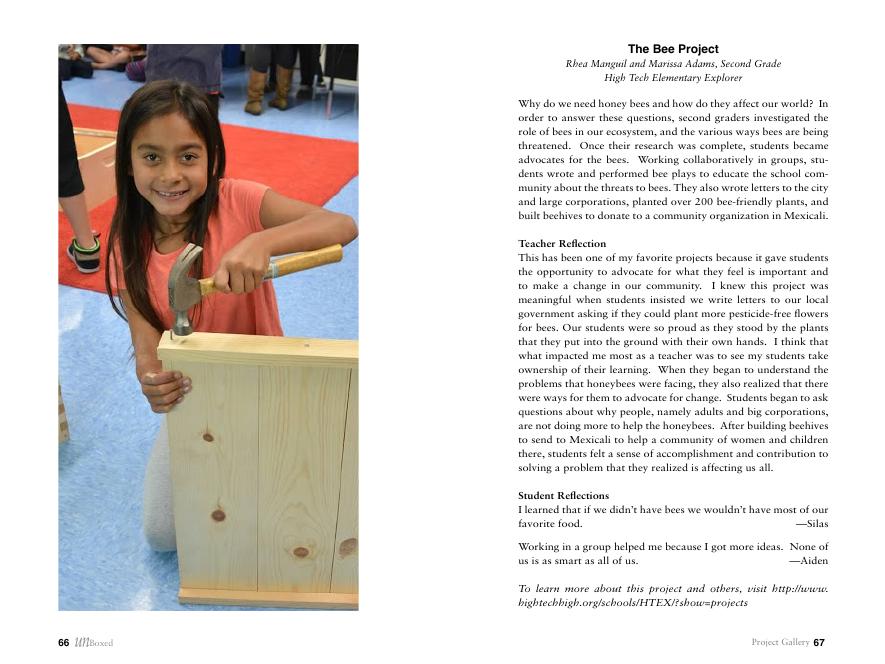
The Bee Project

5th April 2022Duncan Robertson

Why do we need honey bees and how do they affect our world? In order to answer these questions, second graders investigated the role of bees in our ecosystem, and the various ways bees are being threatened.


View or download

Once their research was complete, students became advocates for the bees. Working collaboratively in groups, students wrote and performed bee plays to educate the school community about the threats to bees. They also wrote letters to the city and large corporations, planted over 200 bee-friendly plants, and built beehives to donate to a community organization in Mexicali.

Teacher Reflection:

This has been one of my favorite projects because it gave students the opportunity to advocate for what they feel is important and to make a change in our community. I knew this project was meaningful when students insisted we write letters to our local government asking if they could plant more pesticide-free flowers for bees. Our students were so proud as they stood by the plants that they put into the ground with their own hands. I think that what impacted me most as a teacher was to see my students take ownership of their learning. When they began to understand the problems that honeybees were facing, they also realized that there were ways for them to advocate for change. Students began to ask questions about why people, namely adults and big corporations, are not doing more to help the honeybees. After building beehives to send to Mexicali to help a community of women and children there, students felt a sense of accomplishment and contribution to solving a problem that they realized is affecting us all.

Student Reflections:

I learned that if we didn’t have bees we wouldn’t have most of our favorite food.

—Silas

Working in a group helped me because I got more ideas. None of us is as smart as all of us.

—Aiden

To learn more about this project and others, visit the HTH Unboxed website.

Project Cards,Resources for Schools,The Bridge

Spaces That Matter – Terry White and Bhavini Pandya

3rd April 2022Ali Durban

Developing the spaces and places where children learn and thrive

Terry White and Bhavini Pandya

“Learning is not the product of teaching. Learning is the product of the activity of learners.” – John Holt, American author and educator.

The concept that childrenʼs learning does not follow as an automatic consequence of what they are taught is well established. Loris Malaguzzi, in developing the Reggio Emilia approach, believed that children are capable individuals with the ability and desire to develop their own knowledge. He recognised, as part of his work, the value of space and, in his own words, wanted to ensure “a handsome environment with its potential to inspire social, effective and cognitive learning”. His thinking was influential in developing the concept of space being described as the “third teacher”.

Such an approach focuses on meeting the needs of the whole child and involves moving from a culture of teaching to a culture of learning, and where learning experiences move towards the design of a meaningful, empowered and creative world for children, enabled by the teacher.

The spaces and places where children learn therefore matter and they are inspired by aspirational pedagogy. It follows that the design of all environments for learning should be both learning and learner-led and set within the distinctive culture, ethos and values of the school and its learning community. Our experience working with many schools has been that you canʼt successfully design education spaces unless you fully understand the learning and teaching practices that they need to support.

Planning Learning Spaces in Practice, and Autens, have worked together in collaboration with Gesher School to help make a reality of the schoolʼs vision for learning through the design of learning environments for the school and community. Gesher is developing an approach that is focused on a learner-centred curriculum and is designed to develop the whole person, balancing “head, heart and hand”.

The scope at Gesher embraces conventional areas such as ʻclassroomsʼ (flexible furniture design and arrangement, decor, resources and equipment, images, fluid links between rooms), display areas, corridor environments, dining and social areas.

It also involves the co-design of an ambitious integrated Maker Space; creation of large exhibition areas; and creative incorporation of external environmental features into the everyday learning ecosystem of the school.

Lene Jensby Lange at Autens recognises that “learning environments are an expression of a learning culture and need to be designed to strengthen that culture”.

As a team we are excited and honoured to be part of the learning journey of Gesher School seeking collectively to reimagine opportunities for learning. We are confident that by creating an active engagement process around current and future practice with teachers, learners and community, a transition to new and innovatory learning environments can occur. We believe that teachers and learners must be fully engaged and empowered to fully contribute to the design process.
As a design team, we have engaged with learners and school staff to develop thinking about what will excite, motivate and interest learners and teachers in the design and furnishing of the learning spaces. It has been inspiring to see the level of detail and innovative thinking that learners and staff have brought to the design of spaces, both inside and outside the building.

Learners and staff together are becoming the creators and designers of the spaces and places in which aspirational learning will occur.

“The task of good school design is to create the best physical environment – the best habitat — for that to happen. For that reason, reimagining schools is one of the most creative challenges in contemporary education.” Sir Ken Robinson. Planning Learning Spaces. (Hudson and White) Laurence King Publishing.

Bhavini Pandya and Terry White are co-directors of the Planning Learning Spaces in Practice Projects. Sir Ken Robinson was a British author, speaker and international advisor on education in the arts to government, non-profits, education and arts bodies.


Professional Prompt Questions

  • Is the vision of the school reflected in the day-to-day learning experience for all?
  • Whose needs does the learning space serve?
  • What value do you place on learners taking responsibility for their own learning?
  • How dynamic and adaptable are your learning spaces?
  • Are your learning spaces encouraging enquiry, collaboration, creativity and physical movement?
  • Are you placing equal value on inside and outside learning spaces?
Article,Issue one,Learning,Rethinking Education,The Bridge Article Learning SEND

Emotional Resilience in Children: Building an Essential Curriculum – Lucy Bailey

3rd April 2022Ali Durban

Building an Essential Curriculum

Lucy Bailey

The Mental Health of Children and Young People (MHCYP) survey found that one in six children aged 5-16 had a probable mental health disorder in 2020. Earlier data showed that only a quarter of these children had contact with a mental health specialist, and one quarter had no support at all.

The consequences of not addressing early mental health issues extend to adulthood, limiting opportunities. As it currently stands, education is not geared towards equipping children with the skills and tools they need to live happy, healthy lives. There needs to be a fundamental shift in understanding about the role schools can play in the long-term health and wellbeing of our future generations. When young people feel connected to their schools (and their families) this can protect against the risk of:

  • Suicide
  • Disordered eating
  • Susceptibility to injury
  • Violence
  • Substance abuse, and
  • Emotional distress.

This is why Bounce Forward is passionate about supporting schools to build a curriculum that equips children and young people with the essential tools to develop emotional resilience and psychological fitness; preparing them for life, not just exams.

What does a positive emotional resilience curriculum look like?

There are four core elements that Bounce Forward teaches young people in their lessons:

  1. How to deal better with education and life pressures so they bounce forward in and beyond school
  2. The mental resilience skills to think flexibly and realistically to adapt and respond to challenges and make the most of opportunities
  3. The emotionally intelligent capacity for empathy, compassion and hope
  4. How to be proactive agents for change about the things they care about, and that matter most for humanity.

This article focuses on two of these four areas, exploring how each can be taught as part of an emotional resilience curriculum.

Teaching Optimism

Optimistic thinking is not the same as positive thinking. Learned optimism is the ability to focus on the positive whilst not ignoring the negative. The idea is that if there is a choice (and there often is) it is more productive and helpful to pay attention to the positive that can be found amongst the negative. To teach optimism, first we have to understand the link between thoughts, feelings and behaviour. This is possible using a well-established and simple cognitive behavioural model that helps break down situations into facts, beliefs and consequences.

The theory suggests that when things happen, we interpret them, deciding what has caused the situation, or the implications of the situation. It is our interpretation or beliefs in that moment that influence our emotion and our behaviour. Imagine three people in the same situation – stuck in a traffic jam. 

Person one thinks “some idiot has been driving too fast”, feels angry and beeps their horn. Person two thinks “there is nothing I can do about it”, feels calm and takes the opportunity to listen to their favourite tune. Person three thinks “I am going to be late to pick up the children from school”, feels anxious and clutches their head in their hands. 

One situation, three different responses (emotions and behaviour) because each person’s beliefs about the situation were different.

This simple understanding offers choices: If I don’t like how I am feeling and behaving, then I can reframe my thinking. It leads to a sophisticated understanding of self as patterns emerge: In these types of situations I can react in an unhelpful/helpful way.  It supports the ability to clearly explain what is going on for me: This happened, the facts were x, y, z. I believed ……. to be true and I felt ……. and responded by doing ………. 

This foundational learning has been proven to see sustained long-term positive outcomes.

But please donʼt make the assumption that the goal is for young people to feel happy all of the time. Almost by contrast, the goal is to help young people explore alternatives, look for evidence for what they believe to be true, challenge their viewpoint and develop the psychological muscle to overcome setbacks and make the most of opportunities.

This is achieved by teaching skills and providing the opportunity to practise and master the skills.

Teaching Compassion

Compassion comes when we are faced with another personʼs suffering and we want to do something to relieve that suffering. Learning how to be compassionate starts with understanding emotions, the range of emotions we can feel and what happens in our bodies and minds when we experience certain emotions. This understanding offers the opportunity to first understand our own emotions and then to build empathy, the ability to take the perspective of and feel the emotions of another person. It is this understanding that drives us to be compassionate because we can understand what someone else is going through.

By supporting young people to recognise the differences between positive and negative emotions and the associated levels of energy that are spent (or wasted) with strong emotions, they can develop strategies that help them manage their emotions and therefore their energy, and themselves, more effectively.

Positive emotions can often take a back seat, while we pay attention to negative emotions, but they really are important. When we feel good, (happy, content, relaxed, at ease, receptive), we are better equipped to problem solve and think creatively in the moment, which in turn builds personal resilience such as social connections, and physical and psychological resources. So, supporting young people to recognise their positive emotions is not a ʻnice to haveʼ part of teaching; it is essential to equip them to deal with adversity.


Conclusions

Optimism and compassion can be viewed as ʻsoftʼ, ʻnice to havesʼ but there is nothing soft about them, they are essential and a part of core learning we should be teaching in school to all of our children, especially those who face learning challenges. Building a curriculum and teaching it in a scientific way will help all our young people to not only survive, but thrive.


Lucy Bailey is Chief Executive Officer and Founder of Bounce Forward. She is proud of her beginnings as a youth worker and her 17 years of experience of working in, developing, reforming and managing childrenʼs services. Over the last 12 years Lucy has focused on education and has been instrumental in embedding resilience curricula in schools and services across the UK. Her passion is to drive a movement to influence UK policy around education to form a positive system of change. Lucy directed the Healthy Minds research project, has an MSc in Practice Based Research, a BSc in Social Policy and Criminology, and a Post-Graduate Certificate in Education.


Professional Prompt Questions

  • To what extent do you see yourself as responsible for your studentsʼ emotional health?
  •  In what ways might staff in schools role-model compassion?
  • What tools can you give children to deal with adversity?

Useful Resources

Mindfulness In Schools

Action for Happiness

Five Ways to Wellbeing

Article,Issue one,Rethinking Education,The Bridge,Wellbeing Article Culture Emotional Health Happiness Mental Health Relational Learning

Putting Design Principles at the Heart of a School – James Wetz

1st April 2022Ali Durban

Putting Design Principles at the Heart of a School

James Wetz

I was involved in an advisory capacity during the gestation of Gesher, and at its birth. Asked for this journal to reflect on that period in this extraordinary schoolʼs development, I am driven back to my own belief system -to what the education project is all about. In summary, there are three questions or ʻasksʼ that I would put to all those who work in our schools.

The first: Reflect on how important relationships between staff and young people are

The first challenge to historical models of schooling is that we should reflect on just how important the staff who work with young people in our schools are for each and every young person, and in particular for those more challenging young people who find it difficult to engage with their schooling. This leads at the outset to an emphasis on four key ideas:

  1. That relationships should be the building blocks of school design
  2. That we all learn in and through relationships
  3. That we cannot teach children we do not know and know well
  4. That teaching is a ‘relational activity’ based on ‘educational tasksʼ.


The second: Take a holistic view of education

The second challenge is that we see young peopleʻs educational journey from early
childhood to young adulthood in a more holistic way and, additionally, that we ensure
that there are three equally valued and interrelated components to the educational
design, namely:

  • The importance of relevant learning
  • The personal and social development of young people
  • The professional care and intervention we provide for more vulnerable young people.


The third: View building resilience and emotional capital as key toeducational provision

The third consideration is that we should, quite simply, view emotional capital and resilience as being a crucial part of a teacherʼs role and a schoolʼs mission.


How do these three features relate to Gesher School?

One of the first conversations I had with the schoolʼs founders, Ali and Sarah, was around establishing the core values and principles that would be central to the design of their school – what would be the conceptual framework and belief system that should inform the design of the school they wished to create?

The four underlying principles that were to inform policy and practice in this new school built on the three belief statements set out above, have remained constant to the design and working of the school over time.

They are:

  • The importance of relationships in the education of young people
  • The importance of a holistic approach to the education of young people
  • The importance of building resilience in young people
  • The importance of responding to each young personʻs needs and aspirations


It felt important from the very early design of the school to create a constant emphasis for school leaders, be they the Founders of the school or the Headteacher, to see themselves as architects and designers of the school community in its deepest sense. These design principles would be meaningless without those leaders living them and supporting practice that had these principles at their heart.

“We need to see young peopleʼs educational journey from early childhood to young adulthood in a more holistic way.”


So what could this new school, Gesher School, and other aspirational settings look like if these core principles informed policy and practice and were evidenced in the school?

The key design features of a school that I believe are essential have little to do with buildings and technology provision, important though these are. Rather, they are very specifically those aspects of the school which give explicit meaning and expression to the core principles of a school. Let me share a few of these that I hold to be important for all schools, which have been embedded in Gesher School and I hope continue to be so as they evolve into an all through provision. Whilst I cannot explore these features in detail here, they are for me essentials of what outstanding schools should demonstrate.

They include:

  • The importance of ritual
  • The importance of celebration
  • A listening culture with and between young people
  • Giving teachers time to think about young people
  • Talking together about young people
  • Planning collaboratively to meet the learning needs of young people
  • Paying deep attention to transitions and the managing of endings
  • The importance of roles and boundaries
  • Putting in place effective professional supervision and role consultation for teachers
  • For teachers to have a therapeutic disposition informed by training in attachment and trauma informed approaches
  • The importance of human scale and the primacy of relationships
  • An emphasis on the importance of living in community.


Concluding thought
This is an urgent call for us to set aside preconceived notions of how schooling should be and to think deeply about what it could be or would be if it were to work well for those young people who are currently finding school so difficult to engage with.


Case studies of really well designed schools

As part of authoring and presenting a Channel 4 Dispatches programme titled ‘The Children Left Behind’, I was able to film in the small school movement pilot schools in Boston and New York. Here I met two quite remarkable school leaders and schools. Peggy Kemp, Headteacher at Fenway High School, held staff meetings every day of the week with the total commitment of the staff team and asked just one question of them at the end of every day: ‘Who has not been seriously engaged in learning with us today?ʼ On the day of my visit, when invited to the staff meeting that day and in response to this daily enquiry from the Headteacher, teachers raised the needs of three young people: a boy who had ‘kicked off’ in a bout of extreme anger during the morning session; a normally confident and engaged girl who had seemed sad and withdrawn; and a boy who had missed two weeks of schooling because of domestic upheaval and who was clearly not coping with the work.

What was important, though, was not just their identification as young people of concern on that particular day but the immediate responses of the staff team: “I live near the family of the boy who ‘kicked off in anger’ and will visit on my way home”; that they as a staff group would meet and greet the withdrawn girl with greater love and affection the next day; and that an immediate tutor intervention was necessary to enable the boy who had missed two weeks of school a chance to catch up and cope with his programme.

Linda Nathan was school leader at Boston Arts Academy, which teaches the curriculum through the arts. Linda sees relationships as the essential building blocks of her school and stresses that teachers just cannot be ignorant about the lives of the young people they teach. She sees the need for teachers to show unconditional commitment – persistent care – that the young people should know that the adults will never give up on them, whatever they do. This is the culture of her high-achieving school, where attendance rates are high and exclusions almost unheard of. The staff in her school had a commitment and an understanding to think deeply about the needs of young people who present with challenging behaviour, by providing and affirming a holistic approach to education and seeing relationships as the building blocks necessary for any school if young people were to thrive. There was an understanding that recognised that disaffection from school is often rooted in a lack of early affection; that very challenging behaviour is often a communication about need from children who are acting out due to remembered hurt of earlier neglect, abuse, loss, or separation.


  • Professional Prompt Questions
  • What principles are your school currently built on?
  • If you could design your school from scratch, what principles would you want to guide the way you set up your school? Can you think of a way to embed them where you are now?
  • Is the building of positive relationships between staff and students explicitly designed into the way your school operates? If not, how could it be?
  • Looking at Jamesʼ list of outstanding school features — how many do you recognise in your own school? Would you like to implement any of these?


James worked for over 30 years in state education, 16 as a secondary school Headteacher at both St. Laurence School Bradford on Avon and Cotham School in Bristol. He retired from the role of the Principal of Cotham School and the North Bristol Post 16 Centre in 2004. Subsequently, he has been National Director of Human Scale Education and co-founder of the Consortium for Emotional Well Being in Schools. He has published widely, most notably ʻUrban Village Schools – putting relationships at the heart of secondary school organisation and designʼ, which was published by the Calouste Gulbenkian Foundation in November 2009 and launched at the RSA in London. In 2008 he authored and presented a ʻDispatchesʼ Programme for Channel 4 titled ʻChildren Left Behindʼ based on field work in the small school movement in Denmark and the ʻPilot Schoolsʼ in Boston and New York in the US. He is currently an advisor or trustee of multiple innovative educational and cultural ventures. He is married to Diana, with three children and eight grandchildren.

Community & Culture,Issue one,Rethinking Education,The Bridge Attachment Culture Design Principles Relational Learning

Why Faring Well Really,Really Matters – Laurel Freedmman

31st March 2022realsmart admin

Why Faring Well Really, Really Matters


Laurel Freedman

Looking at what ʻhappinessʼ means to Gesher, it is defined as the need for children to feel broadly secure, to feel satisfied about whatʼs going on with them and to experience a sense of safety in their wider environment In this article we speak to Laurel Freedman, an Educational Psychologist and chair of the Mental Health, Wellbeing and Happiness committee at Gesher, and unpick the schoolʼs Mental Health, Happiness and Wellbeing work, to explore why faring well really matters for children and how you prioritise it in a school.

At Gesher the mental health, wellbeing and happiness (MHWH) of children and adults are core to our ethos. This is grounded in, and driven by, an understanding of what is most important to children and young people.

Children often come to the school having not had their sensory and emotional needs met in mainstream settings, leading to ʻoverwhelmʼ. Overwhelm, and the anxiety that comes with it, blocks children from flourishing and reaching their full potential.

Alternatively, security, safety and solid attachments create the foundations for children to take risks. Learning is all about taking risks; managed risk is at the core of all exploration and education. In short, happy children learn.

“In short, happy children learn.”

This isnʼt only true for children. Staff and parents also need to feel safe, secure and listened to, in order to create the same environment for children. When concentrating on mental health, happiness and wellbeing, Gesher also wanted to create the space and mechanisms for adults to voice their opinions, hear praise and talk about what they needed for their own wellbeing.

The schoolʼs MHWH policy was developed as a means to articulate and pin down the practices they had been developing and refining, in order to keep a record of what they had been doing and to share that with others. The following five steps are drawn from this policy & accompanying work.

Five steps to embedding a Mental Health, Wellbeing and Happiness school ethos

1. Learn from others

Look elsewhere for inspiration and to gather ideas.

For example, Gesher gathered ideas from:

  • The ʻMentally Healthy Schoolsʼ work of the Anna Freud Centre;
  • The Carnegie Schoolʼs Centre of Excellence for Mental Health in Schools, working with the centre in the form of grantees, as well as governors
  • Schools with similar cohorts to the children at Gesher, where they asked to review the schoolʼs policies, undertake visits & take ideas

“Itʼs important to note that Gesher is still in learning mode, and probably always will be.”

2. Establish governance for the work

Gesher established a Wellbeing Committee, comprising the CEO, School Wellbeing Lead & Music Therapist, and School Educational Psychologists, focussed on:

  • Bringing challenge and rigour to the development of the schoolʼs approach
  • Building a MHWH curriculum
  • Establishing impact measures & celebrating successes
  • Embedding the work across the whole of the school.

(A school wanting to establish its own committee might also want to include pastoral care and safeguarding leads.)

3. Build the right team, skills and approaches

On top of the committee, the school also appointed multidisciplinary specialist workers to meet specialist needs that some children might have. These included:

  • A SENDCo
  • A wellbeing lead
  • A drama therapist
  • An educational psychologist
  • An Occupational Therapist, and
  • A Speech and Language Therapist.

However, Gesherʼs MHWH approach is ʻwhole schoolʼ, meaning itʼs owned by everyone. The work is designed to feel connected and to promote the fact that everyone has skills and a role to play in promoting it.

Whilst some staff are appointed for their specific expertise, every member of staff is trained and supported to spot early warning signs and the different needs of each child. There are also displays, celebration assemblies and constant discussion opportunities in the school to talk about it.

4. Create tailored support strategies for each child, promoted by your curriculum

Each child has a tailored support strategy, focusing on hearing each young personʼs needs and voice.

This strategy closely involves families, building important links between home and school. These strategies, and the emotional scaffolding tools used within the curriculum encourage:

  • Children to feel confident
  • Effective expression of emotions
  • Relationship building
  • Ability to cope with stresses of life & deal with change
  • Independence

Activities that promote this include:

  • Pupil-led activities: self expression day; opportunities to share feelings or lead activities
  • Class activities: Middah slips where staff recognise the positive impact of student action; timetabled relaxation time; mindfulness
  • Whole School activities: Jewish faith ethos to ʻlove thy neighbour as thyselfʼ; celebration assemblies; and displays about positive mental health.


5. Think about your impact & how you assess wellbeing

Observe changes in the resilience of children (and adults) who face adversity and struggle. The coronavirus pandemic, for example, helped the school to see this in action. Gesher was able to stay open during lockdown, knowing that stability was needed for children. But staying open wasnʼt the only thing that created that safety. The children were still able to thrive and learn during such a difficult time because of the consistent and tailored support strategies put around them. supported and listened to? Do they feel like owners of the work?

Talk to parents. Parents have told us that they have a ʻdifferent childʼ, they describe the changes to their childrenʼs interests, interactions, appetite for learning and in the way they look forward to things. All teachers will observe this themselves, but itʼs really validating to hear parents observe it too.

Ask your staff for feedback regularly. Do they feel supported and listened to? Do they feel like owners of the work?

The above steps are drawn from one schoolʼs learning journey to date. Itʼs important to note that it is still in learning mode (and probably always will be). Their next focus is an exploration of adolescent transitions and good mental health.

Professional Prompt Questions

  • Whatʼs needed to guarantee children feel secure and valued in school?
  • How can schools ensure that children are really well known, and that they know that they are known?
  • How do you build security and support for staff in SEND schools?
  • How can you make mental health, wellbeing and happiness everyoneʼs business in school?

Laurel trained as a primary school teacher over 40 years ago and has had a number of roles and professions both in England and Israel, including teaching adults and pre-school children, and childminding. After qualifying as an Educational Psychologist (EP) in 1996, she worked for the London Borough of Enfield for seven years and then moved to Norwood (Binoh) where she managed the EP team, working predominantly within the Jewish community. During this time, she also spent five years on a secondment to the Tavistock Centre, working as a part-time course tutor on the Doctorate for Child, Community and Educational Psychology. Since leaving Norwood in 2013, Laurel has worked as an independent EP and is now semi-retired.

Article,Issue one,Teaching & Learning with Neurodiverse Children,The Bridge,Wellbeing Article Emotional Health Happiness Mental Health Policy SEND The Bridge Wellbeing

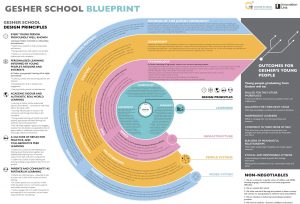
Gesher Design Principles

29th March 2022realsmart admin

Gesher Design Principles

EVERY YOUNG PERSON IS PROFOUNDLY WELL KNOWN
Learning at Gesher is founded on relationships and attachment:

  • Adults know students as both young people and learners
  • Young people know and support one another
  • Gesher is a community of ambition built on relationships and compassion.


PERSONALISED LEARNING INFORMED BY YOUNG PEOPLE’S PASSIONS AND INTERESTS

At Gesher young peopleʻs learning will be highly personalised:

  • Fostering curiosity and discovering passions and interests
  • Developing from that to ambition and engagement
  • Ensuring holistic growth and development


ACADEMIC RIGOUR AND AUTHENTIC REAL-WORLD LEARNING

  • Learning at Gesher will be academically rigorous and authentic – connected to real-world tasks in the adult world
  • Learning will take place in school, in the community and through internships in the workplace
  • Young peopleʼs learning will include real-world projects, appropriate skill-based learning, and authentic real-world assessments
  • We will design together rigorous and engaging projects that will develop young people’s sense of agency, ability to collaborate constructively and encourage collective
    achievement.


A CULTURE OF REFLECTIVE PRACTICE AND COLLABORATIVE PEER LEARNING

  • Gesher has a culture of staff reflecting and thinking about their practice together, and collaboratively planning how to improve outcomes for each and every young person
  • Gesher has a culture of peer teaching and tutoring enabling young people to learn from one another.


PARENTS AND COMMUNITY AS PARTNERS IN LEARNING

  • Parents are critical partners – expected to play an active role in their child’s school and home learning
  • At Gesher, parents are our partners in their child’s education, and our community supports and enables learning to happen
  • Gesher engages with the wealth of experience and expertise in our community, and we create opportunities for volunteering.


Article,Community & Culture,Issue one,Rethinking Education,The Bridge Article Culture Design Principles SEND The Bridge

The Value of Getting it Right for Each Child: A View From Parents

29th March 2022realsmart admin

ʻThe Bridgeʼ is an adult learning journal for and by educators — which includes community members with an interest in young peopleʼs learning. This first issue would not be appropriately balanced if it didnʼt include the voice and reflections of parents. In fact, we intend that every issue of ʻThe Bridgeʼ will include articles by parents and community members who have experiences to share.

What it feels like when a school doesn’t understand your child?
Our daughter was previously in a local mainstream school with 1:1 support. She would regularly be separated from the other children in her class in order to receive various therapies and in order to carry out her learning. We knew she wasnʼt happy because we had frequent reports of her pulling her learning assistantʼs and other teaching staffʼs hair. She started stimming (self-stimulating behaviour) at this time by waving her arms around; this was evidently her way of coping within the experience of boredom and isolation and yet it marked her out as different, leading to yet more of a sense of alienation both on her part (and mine).
Our daughterʼs difficulties in all areas such as speaking, attention, large motor movements, were making it difficult for her to join in classroom activities. It was clear that she was suffering from anxiety.

She was being and would be increasingly failed by the mainstream education system

and I could see things would only get worse if we didnʼt find another school for her. The staff within her school were clearly overwhelmed and they didnʼt really know how to support us or how to deal with us. This was obvious from our meetings with them. They didnʼt know how to help our daughterʼs learning, nor did they know how to help manage her behaviour and it was evident that we represented a burden or a problem for them. I didnʼt have much of a connection or common point of contact with other parents owing to our experience being so different. Our daughter lacked confidence when she was in peer group situations and she would often shrink back and stick to the adults in the room. I recall birthday parties and park playgrounds being particularly tense times for both of us.

How did you know when you had found the right school?
You can tell when a school knows what it is doing. When we found Gesher, the corridors were calm and distraction free and there was an atmosphere of peace and contentment and also a positive can-do attitude amongst the staff. It was clear to us that this was going to be the best place for our daughter, not least because her severe speech dyspraxia was making any kind of integration into mainstream schooling increasingly complicated. We knew that people would take the time to listen to her and to try to understand what she was saying, that she would be encouraged to communicate. She would be able to join in group activities without being separated. Immediately, we felt that Gesher would see us not as a problem or hindrance, but rather as an opportunity.

What it means to belong
When children are encouraged to feel a sense of belonging to their school, not just to their class, that is really important. A whole-school focus on inclusion, support and nurturing of children means that children are encouraged to learn good values and the importance of taking responsibility for themselves and for others. This is crucial.

I really appreciate here that therapy is integrated, meaning no child is singled out or isolated, while at the same time each student has their own learning plan. Each child is included and also cared for.

When your child (and you) are truly seen and valued
Our daughter has flourished, blossomed even, into a confident young girl who has a strong sense of who she is. She is no longer scared to try new things. Her ability to focus and to give her attention to a task has grown too. Her speaking is improving day by day. She is so happy to be part of a wider community. She wakes up each day with a sense of purpose and curiosity which is exactly how we should all be in life.

As parents, we no longer feel alone in the experience of having a special needs child.

When we go through a difficult time, or we have a specific issue, or we need some practical help, we know that we have other parents and teachers to whom we can reach out. That has made a phenomenal difference to our lives. We have started to feel a sense of optimism about our future as a family.

Article,Issue one,Teaching & Learning with Neurodiverse Children,The Bridge,Wellbeing Article Parents

How to Lead Profound Educational Change: A Reflection from Big Change

29th March 2022realsmart admin

How to Lead Profound Educational Change

Caitlin Ross and Caireen Goddard, Big Change

Have you looked at our traditional systems of education and thought, “Surely we can do better for young people?” Big Change is an organisation that is generating a national conversation around ten hopes for how we could do just that.

Gesher School caught up with Caireen Goddard and Caitlin Ross, who lead the impact team at Big Change, to hear about these hopes and what it might take to change the system.

Gesher
First of all, thanks for speaking to us today and for letting us hear about the hopes of Big Change. I’m going to dive straight in: What needs to change about the education system?

Caireen Goddard
When I came to Big Change I had spent a lot of time in and around the education system, including learning from educators in the UK and examples from around the world where people were doing things really differently. I recognised the frustration of people in our schools and local authorities who wanted to do things differently, and to support young people in different ways, but who had blockers put in their way or were under pressure to deliver against certain kinds of outcomes. There was, or is, a double tension of a narrowing focus from above together with a lack of autonomy or freedom to lead education in a way they thought was really needed for young people.

I think it boils down to two really key questions:

  • What should be the purpose of education?
  • Whatʼs really important for children and young people to learn – for themselves and for society?

Across 2021 we ran a Big Education Conversation where we asked these two questions. Most people we heard from agreed that we need to rethink the purpose of education and shift to a system where childrenʼs enjoyment of and engagement in learning is paramount.

Gesher
It sounds like thereʼs a real drive for change, but what should that change look like?

Caireen
Thatʼs right, we know thereʼs an appetite for change. And we think that ʻbig changeʼ would:

  • Recognise that a one-size-fits-all model actually fits no-one.Even children who are ʻdoing wellʼ within the current system arenʼt satisfied with it because of the modes of learning and pressure from exams.
  • Create an inclusive learning system that prepares all children well for the real world.
  • Take a broader perspective on who our educators are. If we want our young people to learn skills that equip them for life, look at the degree to which the broader community,
    employers, parents, and young people themselves are involved in the nature of learning provision.

Gesher
So, tell me more about Big Change and your hopes for changing the system?

Caitlin Ross
We want to be a catalyst for change by working with and through others. We want to learn from others and create the space for hope and ambition, and to disrupt the status quo. Our Ten Hopes, which have been published as a call to action to frame our work and invite others on the journey, have really resonated with a lot of people. Instead of getting caught up in how negative the system and all its problems can feel, we wanted to orientate towards the hopeful.

Gesher
With that in mind, how do you work with change-makers like Gesher?

Caitlin
I lead on our grantmaking work and was lucky enough to be part of Gesherʼs application process. Before we met today, I took a look back at their application to see what it was that stood out.

What we really liked, and what we would look for with change-makers, was the drive to challenge the status quo on what education is and how it can be delivered. We really liked their goal around ensuring that all pathways through education and into work are valued, and also:

  • An ability to think outside the box about what traditional models of ʻsuccessʼ should be
  • The ambition for young people with special educational needs and disabilities to have meaningful professional and wider lives
  • The desire to convene everyone who will be supporting these young people at different stages of their lives
  • Challenging common sense and really looking at what young people with SEND need to live rich, fulfilling lives
  • The drive to bring other schools and professionals along with them on their learning journey. They really want all ships to rise with their tide and that is the perfect service we can provide for children.

Gesher
What advice would you give to Gesher, and others, when trying to implement change?

Caitlin
You need the right conditions to see these goals through. So, I would really say that you need:
• An ability to think about the whole system
• To be open to insights from elsewhere, all over the world
• To observe what you are learning and question yourself – to interrogate
• Be ambitious about the change you want to create with and for young people, while being humble enough to work collaboratively and learn from others
• To be strategically generous – donʼt hold on to your knowledge
• Recognise that you will always be learning.

Gesher
It feels like this could be quite a daunting challenge to take on. Whatʼs one thing people who want to lead change should think about?

Caireen
I donʼt think itʼs helpful to give the impression that any of this is straightforward or easy. Being a path-finder means you are taking a risk in the context of young people and their learning, which understandably isnʼt a hugely risk-inclined environment. I think itʼs about finding opportunities to do things differently and being confident to try new approaches. Looking to others for support and inspiration, both domestically and internationally, because we need real collaboration over competition.

Caitlin
I agree with that and would also say, donʼt just surround yourself with like-minded people. One way to create significant change over time is to collaborate and align with people who
have quite different views from you. Those unlikely alliances are really important, but like all partnerships they take a degree of willingness and trust to make happen, as well as humility.

Gesher
This has been fascinating. Just to end, do you have any final thoughts or advice you would like to give to Gesher or other change-makers?

Caireen
I would say that itʼs easy to lose sight of the quick wins, so celebrate the small successes!

Caitlin
I think having a clear vision of the change you want to create for and with young people and putting them at the centre of the work is really, really important to drive any change.


Caireen Goddard leads Big Changeʼs global insight network and their system change strategy in the UK, which is centred on Subject to Change, a new national project that will empower young people and the public to set a new direction for learning. For over 20 years Caireen has worked on learning, strategy, networks and innovation projects with schools, local authorities, charities, various national and global bodies, and central government.

Caitlin Ross leads on the identification, funding and support of pioneering project partners. She also leads on Big Changeʼs impact strategy, making sure that they gather the insights needed to keep growing and learning, both as a charity and as a funder. Caitlin has a frontline background in microfinance and in youth work, working on the ground with organisations in Europe, Africa and the Caribbean. She brings her experience delivering scalable, impact-focused interventions to Big Changeʼs grant giving and impact work to support pioneers who are helping young people to thrive in life.


Professional Prompt Questions

  • What would you want life to look like in 20 yearsʼ time for the children you teach and how well are current schooling practices preparing them?
  • What would you choose to assess if you set up an education system that prepared children to be good citizens?
  • Who do you view as educators of children and young people?
  • How do you raise all the ships around you when you are gaining knowledge and trialling new educational approaches?
  • Who do you look to for ideas?
Article,Issue one,Leadership,Rethinking Education,The Bridge Article Educational System Funding SEND

Where are all the SEND Teachers? 

21st February 2022Website Admin

By Rowan Eggar

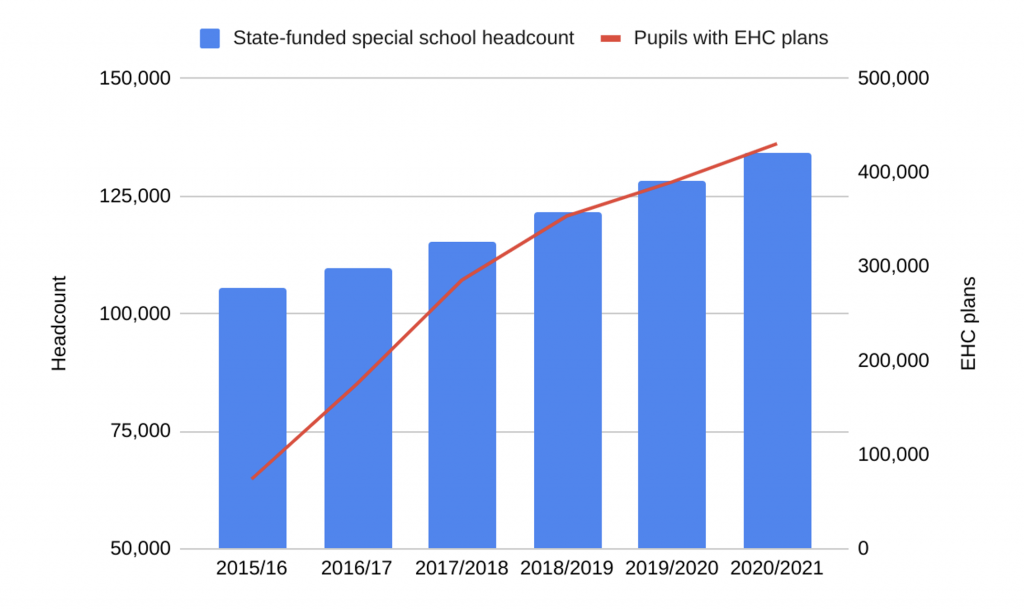
Nearly half a million children in the UK have Educational Health Care Plans (EHCP). This represents a 480% increase since 2016. State-funded special schools have seen a 22% increase in pupil headcount over the same period. In addition, a further 12% of mainstream pupils require SEN support from nursery to the end of secondary school.  

Yet despite this, recruitment of SEND teachers continues to be an uphill struggle. Only 5% of qualified teachers work in special needs settings or PRUs (ONS, 2021) and there is a distinct lack of data on retention rates and the number of foreign teachers. This further highlights the problem, SEND teachers are not considered when looking at recruitment and retention despite the ever growing number of pupils with additional needs (OECD, 2019). 

A solution to this problem needs to be found to help these vulnerable and extraordinary pupils.  

Retention of Teachers   

The special needs teacher shortage is not limited to SEND.  It is a nationwide problem. Teacher retention is another uphill struggle. Current statistics are telling, with only 67.4% of teachers remaining in the profession after five years (EPI, May 2021). The government is attempting to address these issues with the roll out of ECT training, designed to better support and mentor new teachers. However, I would argue that placement of ECT teachers in schools they already have a relationship with would produce more high quality teachers. Firstly, these teachers have a solid understanding of the ethos and values of the school, which they may also embody. Secondly, knowledge and practice of key areas including behaviour, curriculum and safeguarding procedures. Finally, their interpersonal relationships with colleagues and the senior leadership team will provide a support network during those early and overwhelming trainee years.  

Retention of teachers is a huge problem and workload is at least partially to blame. A primary teacher is averaged to spend 52 hours a week working, which when coupled with relatively low pay and a public sector pay freeze highlights the complexities of the problem. Special needs teaching is notoriously challenging and does require a certain type of individual. However, if the right training route was in place perhaps we would be better able to identify and support the issues of teacher retention. 

COVID 19  

COVID 19 has affected SEND staff shortages significantly and is having a profound impact on staff recruitment. Unlike here in the UK, South Africa, Australia and New Zealand all have specialist SEND teacher training, whose highly skilled teachers previously made up a large proportion of our SEND teachers. Now with Covid 19 continuing, many of these individuals have gone back home. With ever changing regulations and differing quarantine regulations, there is no clear return date for them. Anecdotally, our school alone has lost 10% of teachers and teaching assistants.  

No specialist training  

In the UK, there is no specialist SEND teacher training in either the PGCE or BA education route.A recent survey showed the top two reasons for teachers handing in their notice were lack of training in managing student behaviour and SEND (TES, 2019). ⅓ of teachers would like further training or CPD on SEND. Pupils in specialist settings have a range of mild to severe needs from social communication to social emotional mental health to profound learning disabilities. Therefore, they require bespoke and comprehensive training to help them overcome their barriers to learning. While some schools are able to offer CPD and paid for training, many are underfunded and unable to. Often the needs of SEND pupils are so complex that without the correct tools and skill sets behaviour can become dysregulated and pupils are unable to learn. Without appropriate training or the right supportive setting, how can we recruit teachers into SEND? 

Should the UK not be a leading specialist in special needs training like South Africa and Hungry? Being able to be part of a world wide initiative would further attract new teachers and upskill our current educators.  

What can we do about it?  

The first step is to acknowledge the problem and raise awareness. Working together with the government, local authorities and educational think tanks will enable us to discuss the problem and come together to think of solutions. 

The next step is to develop SEND specialist training programmes. Both postgraduate and apprenticeship routes should be considered. Utilising and mentoring the extraordinary teaching assistants already present in schools is one solution. Including SEND placements onto teacher training courses would also increase awareness and provide opportunities for all teachers to learn from our SEND pupils before bringing those skills back into the mainstream and specialist learning environments. 

– Written by Rowan Eggar

Article,Front Page News,Issue one,News,SEND,The Bridge Article SEND Teaching

Post navigation

Newer posts →

School Address

Gesher School

Cannon Lane

HA5 1JF

Contact Info

020 7884 5102

[email protected]

Gesher School, Cannon Lane,
Pinner HA5 1JF
  • 020 7884 5102
  • [email protected]
Useful Links
  • The Bridge
  • Join Our Team
  • Admissions
School website powered by realsmart brand logo
Skip to content
Open toolbar Accessibility Tools

Accessibility Tools

  • Increase TextIncrease Text
  • Decrease TextDecrease Text
  • GrayscaleGrayscale
  • High ContrastHigh Contrast
  • Negative ContrastNegative Contrast
  • Light BackgroundLight Background
  • Links UnderlineLinks Underline
  • Readable FontReadable Font
  • Reset Reset